

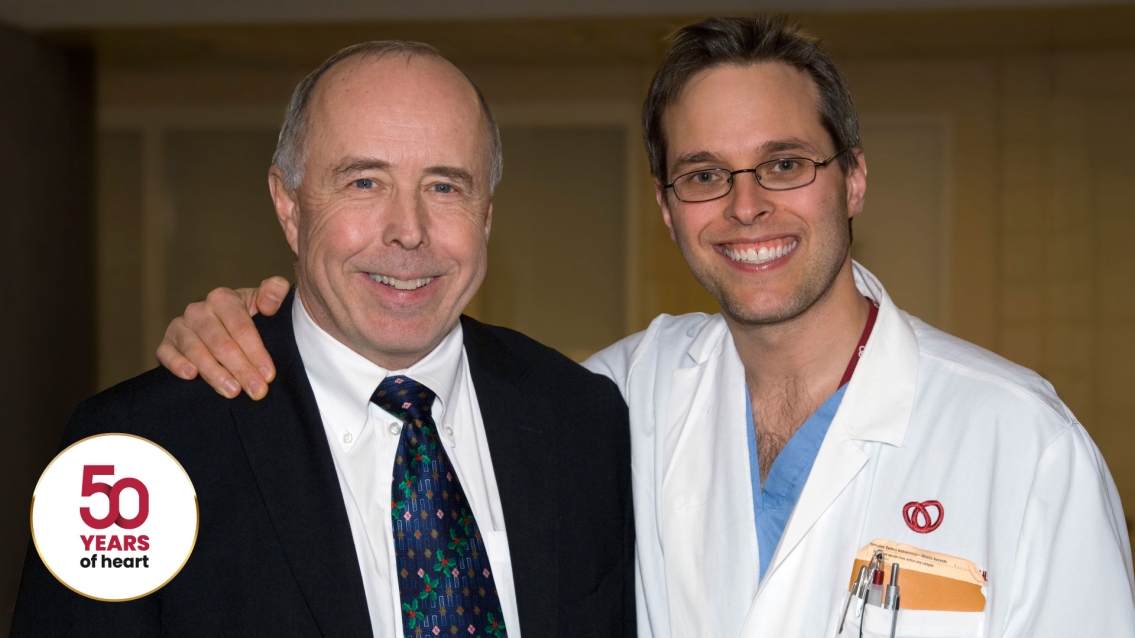
For 50 years, the Ottawa Heart Institute has cared for patients, advanced cardiovascular research and trained generations of physicians, surgeons, nurses and allied health professionals.
Those three pillars – care, research and education – have always been part of the Heart Institute’s DNA. At the heart of it all is teaching.
Dr. Michael Froeschl, director of education for the Division of Cardiology and co-chair of the education committee, said education at the Heart Institute is the mortar between the bricks.
“The bricks are the clinical care, research, technology and expertise that have made the Heart Institute an international leader,” he told The Beat. “The mortar is the culture of education that connects them.”
Purpose-built to train
Dr. Froeschl knows that culture from both sides.
He arrived at the Ottawa Heart Institute in 2002 to train in adult cardiology. After completing his residency and a fellowship in interventional cardiology, he joined the staff in 2006.
Education had always been an important part of his academic interests. In 2013, he became director of the adult cardiology residency program, a role he continues to hold.
He credits his own teachers, including cardiologists Dr. Marino Labinaz and Dr. Lyall Higginson, with encouraging him to pursue his interest in education.
They reinforced early on what Dr. Froeschl was coming to understand about the Heart Institute: that it was a place designed to teach, where excellence in education was as important to the mission as excellence in care and research.
The Heart Institute’s visionary founders, Dr. Wilbert J. Keon and Dr. Donald S. Beanlands, understood the far-reaching impact of teaching.
They believed clinical care could help individual patients, but teaching could help countless patients by creating excellent doctors and researchers. And so, they built a heart institute that has trained many of today’s leaders in cardiovascular care and sciences.
“[The Heart Institute] was purpose-built to train,” said Dr. Froeschl. “This place was designed to do it, and to do it well.”
Learning from one another
Today, education at the Heart Institute extends far beyond cardiology residents.
The Heart Institute trains nursing students, master’s students and learners in pharmacy, technology, biomedical programs and other health disciplines. Their education happens everywhere: during rounds, at the bedside, through simulation and in conversations between experienced staff and people just beginning their careers.
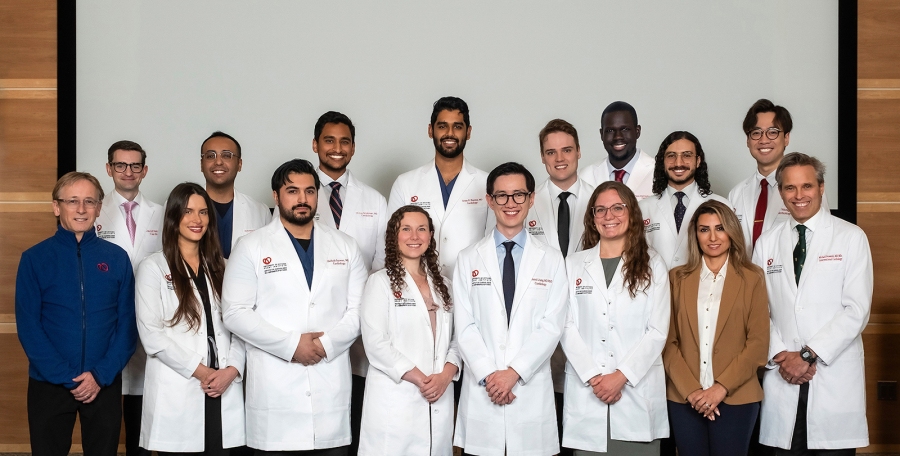
Bonnie Bowes remembers what it was like to be one of those learners.
She arrived at the Heart Institute in 2001 with experience in trauma intensive care and emergency nursing but still had to learn the realities of cardiovascular care.
“When I look back, I realize that most of what I learned in those days came from the people I worked with and from the patients,” she said.
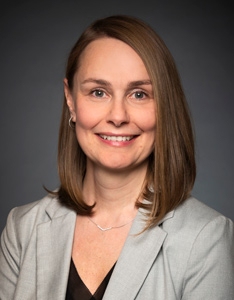
Bowes was mentored into the specialty and eventually became an educator herself, co-developing in the early 2000s a critical care program to better prepare nurses entering the field.
Today, she is the Heart Institute’s vice-president of quality, risk and health information, as well as its chief nursing officer. And, as co-chair of the education committee alongside Dr. Froeschl, she now helps oversee education across the Institute.
“Education is embedded in everything we do, whether that’s clinical education or patient education,” she said. “We want to be a place that trains people.”
Chanele Polenz is a postdoctoral researcher at the Heart Institute whose work explores the relationship between cardiovascular disease and mental health.
“The Heart Institute has strong infrastructure in place to help trainees and postdoctoral researchers prepare for their next career steps,” she said.
That support includes a dedicated Research Services team, help developing competitive fellowship and funding applications, and funding to attend medical conferences. Just as important, Polenz said, is the willingness of colleagues to share their knowledge and open doors.
“Every scientist or clinician I have reached out to has been generous with advice, providing their time and expertise, or passing along opportunities to help our development as future leaders,” she said.
Learners help the Institute evolve and grow, too.
“We come with fresh ideas, diverse backgrounds, and new perspectives,” she said. “We are constantly asking, ‘Is this the best way to do something? Is there another approach?’”
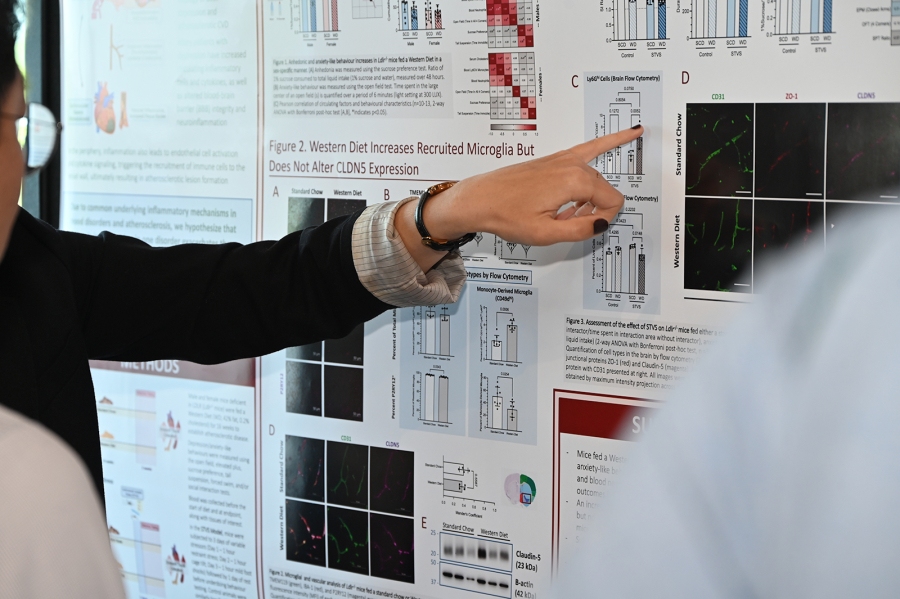
In this way, education becomes more than the transfer of knowledge. Learners contribute to the ideas, practices and innovations that help the Heart Institute become the best place to be a patient, staff member, clinician or researcher.
“Our clinicians and scientists do an amazing job of leading research programs, and we are seen as an important part of the equation,” Polenz said. “The more empowered our trainees and fellows feel, the stronger the Institute will be, and the more impact it will have beyond its own walls.”
A coach’s philosophy
Dr. Froeschl believes the goal of education is to ensure learners at the Heart Institute are trained to do more than simply meet the minimum standard.
“No one is talking about competence,” said Froeschl. “Everyone who works in this building, regardless of their job, is trying to be excellent – whether in clinical care, teaching or research,” he said.
Dr. Froeschl believes people perform at their best when they are both challenged and supported. He often thinks about the relationship between a great athlete and a great coach.
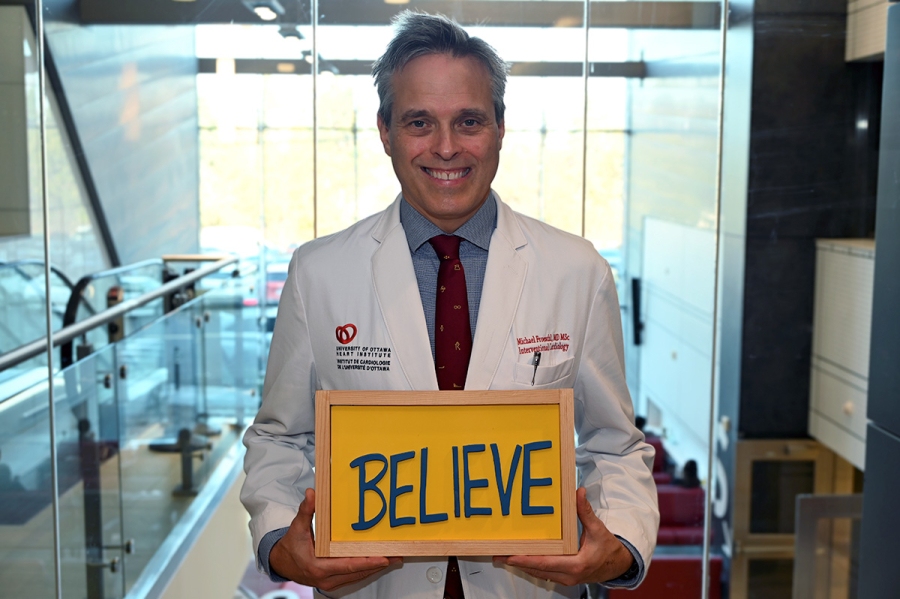
His favourite example comes from Apple TV’s Ted Lasso, the fictional American soccer coach whose leadership style centres on bringing out the best in the people around him.
“[Lasso] is a role model for his ability to bring out the best in his players on the field and the best in people everywhere,” said Dr. Froeschl. “We try to do both of those things here.”
It’s about creating an environment where people can become the best version of themselves.
“We don’t want our learners to survive. We want them to thrive.”
The mortar between the bricks
After more than 20 years at the Heart Institute, both Dr. Froeschl and Bowes have seen technology, clinical practice and education change.
At the Heart Institute, learners are exposed to new approaches and technologies very early, sometimes as early as – or even ahead of – their incorporation into general practice. It’s part of what makes the Heart Institute cutting-edge.
Bowes sees opportunities to use AI to improve efficiency but said new tools need to be evaluated with the same scientific rigour applied to other innovations.
As technology becomes more powerful, the fundamentals of medicine become even more important.
“The challenge for medical education will be preparing clinicians for a rapidly changing world without losing the qualities that make medicine human,” she said.
As the Heart Institute looks to the next 50 years, technology and clinical practice will continue to evolve. But its commitment to excellence, to each patient, and to the human side of medicine will remain at the heart of its approach.
For Dr. Froeschl, that commitment comes down to the people who make education part of their everyday work.
“It’s the buy-in that everyone seems to have when they come here: to contribute, with passion, to this great culture of education,” he said.
It is that culture – built by generations of physicians, surgeons, nurses and allied health professionals – that connects the Heart Institute’s work and will help shape its future.
The mortar between the bricks.
The Ottawa Heart Institute is celebrating 50 years of heart in 2026. Visit our anniversary webpage!
Never miss a Beat
Want interesting stories like this delivered straight to your inbox as they happen?
Subscribe to our mailing list