
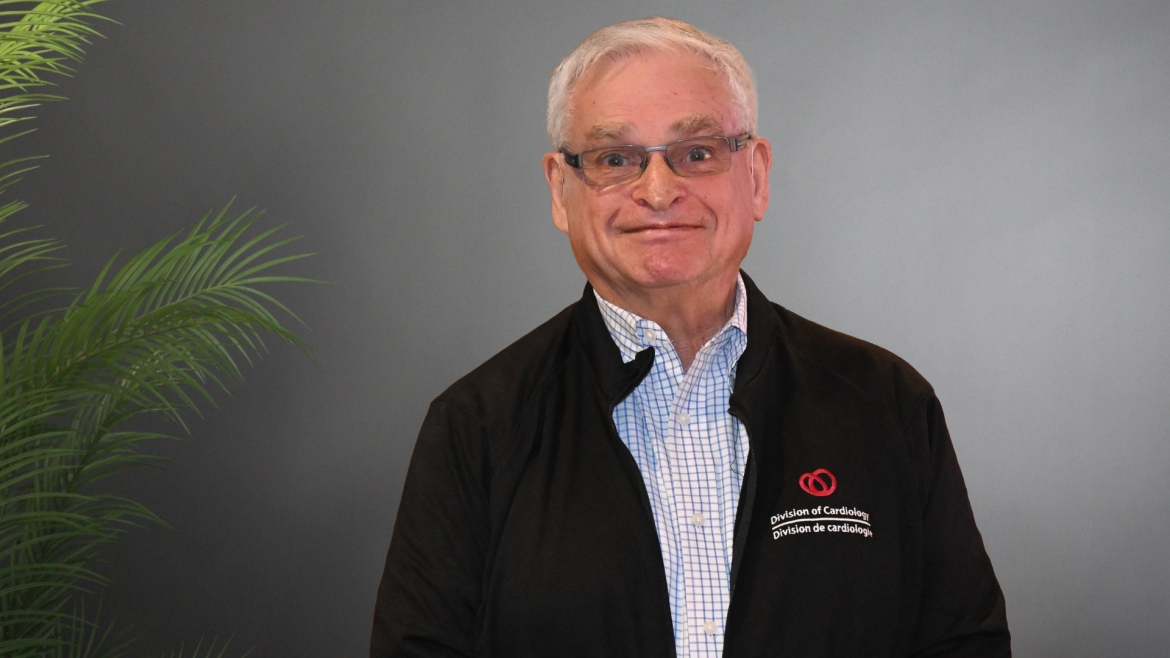
When Martin Green, MD, arrived at the Ottawa Heart Institute as a cardiology trainee in 1978, he could hardly have imagined he would spend nearly half a century shaping a field that barely existed at the time.
Electrophysiology (EP)—diagnosing and treating heart rhythm problems, and now a cornerstone of cardiac care—was in its infancy. There were no mapping systems, no catheter ablation tools, no implantable defibrillators. What existed, mostly, was curiosity, and Dr. Green had plenty of it.
He grew up in a medical household. Both his parents were physicians, but he never felt destined for medicine. He imagined a future in mathematics or physics. “I wandered into medicine,” he told The Beat. “But I wandered into the right place.”
The same was true of cardiology and rhythm disorders: “I didn’t plan it,” he said. “The doors opened, and I walked through.”
A field takes shape
One of those doors opened when then-chief of cardiology Dr. Donald S. Beanlands approached him with a simple directive: electrophysiology was taking shape abroad, and Dr. Green should go learn it—then bring it home. EP didn’t exist in Ottawa yet; Canada had barely begun to explore the field. But the momentum was unmistakable.
Dr. Green went to the Netherlands for his training, working with pioneers like Dr. Hein J.J. Wellens, whose research laid the foundation for modern cardiac mapping and programmed stimulation.
“It was extraordinary,” Dr. Green recalled. “I was in one of the world’s leading centres, learning from the great minds.” For someone who loved science, teaching, and travel, it was an ideal match.
When he returned to Ottawa in 1983, Dr. Green began building what would become the Heart Institute’s arrhythmia service. “I didn’t have a clear vision yet,” he said. “I just knew rhythm disorders caused real problems, and we needed people dedicated to understanding them.”
What followed, across four decades, was nothing less than the transformation of a field.
In the early days, the only definitive treatment for many arrhythmias (heart rhythm disorders) was surgery, a major, invasive ordeal that required opening the chest.
Then came the revolution: energy delivered through catheters. Suddenly, arrhythmias once treated surgically could be corrected through a vein, often with same-day discharge. “That was a massive turning point,” Dr. Green said. “It changed everything.”
Next came devices—implantable cardioverter defibrillators that could detect and stop dangerous ventricular arrhythmias. Conditions once considered universally fatal became manageable. “When you look at the last 40 years, it seems long,” he said, “but in medical terms, it’s actually been remarkably fast.”
A lasting legacy
Dr. Green emphasized these breakthroughs were not the work of one person. Recruiting Dr. Anthony Tang early on doubled the electrophysiology team to two.
It was a pivotal moment.
From there, the team expanded steadily. Today, the Heart Institute has 12 electrophysiologists focused almost exclusively on rhythm care. “That alone tells you how far the field has advanced,” he said.
Perhaps Dr. Green’s most enduring influence has been as a teacher. For 30 years, he and Dr. George J. Klein of London, Ontario, have run a national electrophysiology course for fellows across Canada. Many of today’s leaders in the field once sat in those classrooms. “Colleagues come up now and say, ‘I took your course 20 or 30 years ago,’” Dr. Green said. “That means the world to me. It truly warms my heart.”
He speaks with equal enthusiasm about electrophysiology’s future. He believes ventricular fibrillation—the rhythm that causes instantaneous sudden cardiac death—will someday be understood and treated through catheter-based approaches. And as the molecular and genetic underpinnings of arrhythmias become clearer, he expects an entirely new therapeutic frontier to emerge.
For now, though, Dr. Green faces a different kind of unknown: retirement. After decades of 9-to-12-hour days, the prospect of stepping away brings less relief than many might expect. “I’m already missing it,” he said.
If he struggles to articulate his legacy, it may be because the field he helped build is larger than any one person. But ask around the Heart Institute, and the impact is clear: a thriving arrhythmia service, generations of clinicians he helped train, and countless patients whose lives were saved by innovations he helped bring to Ottawa.
Dr. Green called electrophysiology “a forever field”—one that will keep evolving long after he sets down his catheters. Its story here at the Ottawa Heart Institute cannot be told without him.
Never miss a Beat
Want interesting stories like this delivered straight to your inbox as they happen?
Subscribe to our mailing list