
For much of modern medicine, heart disease was considered a man’s disease.
What doctors knew about cardiovascular disease was based largely on research involving men. Women were underrepresented in clinical studies. Their symptoms could be different, and some of the conditions and risk factors affecting women were poorly understood.
The consequences were significant: women could face delays in diagnosis and treatment, even though cardiovascular disease remains the leading cause of premature death among Canadian women.
At the Ottawa Heart Institute, a group of clinicians and researchers began asking what could be done.
The answer became the Canadian Women’s Heart Health Centre.
More than a decade later, the Canadian Women’s Heart Health Centre has grown from an Ottawa initiative into a national leader in women’s cardiovascular health, with work spanning clinical care, research, education and advocacy.
And throughout its evolution, one principle has remained central: listen to women.
It started with listening
The conversations that led to the Canadian Women’s Heart Health Centre began around 2011 and 2012. Dr. Andrew Pipe and Dr. Bob Reid, leaders in the Heart Institute’s Division of Cardiac Prevention and Rehabilitation, recognized the need for a greater focus on women’s cardiovascular health.
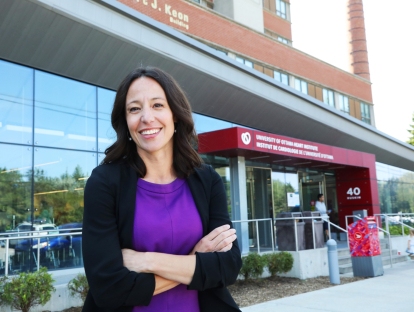
Kerri-Anne Mullen, then a scientist at the Ottawa Heart Institute, was part of an early advisory committee.
The first step was to find out what was missing.
“The team started with reaching out to the community—conducting surveys, interviews, needs assessments, and systematic review—to understand where the gaps were,” Mullen recalled.
National surveys revealed significant gaps in awareness, attitudes and lifestyle, as well as gaps in public understanding of women’s heart disease and among healthcare professionals in their knowledge of sex-specific risks, symptoms and conditions.
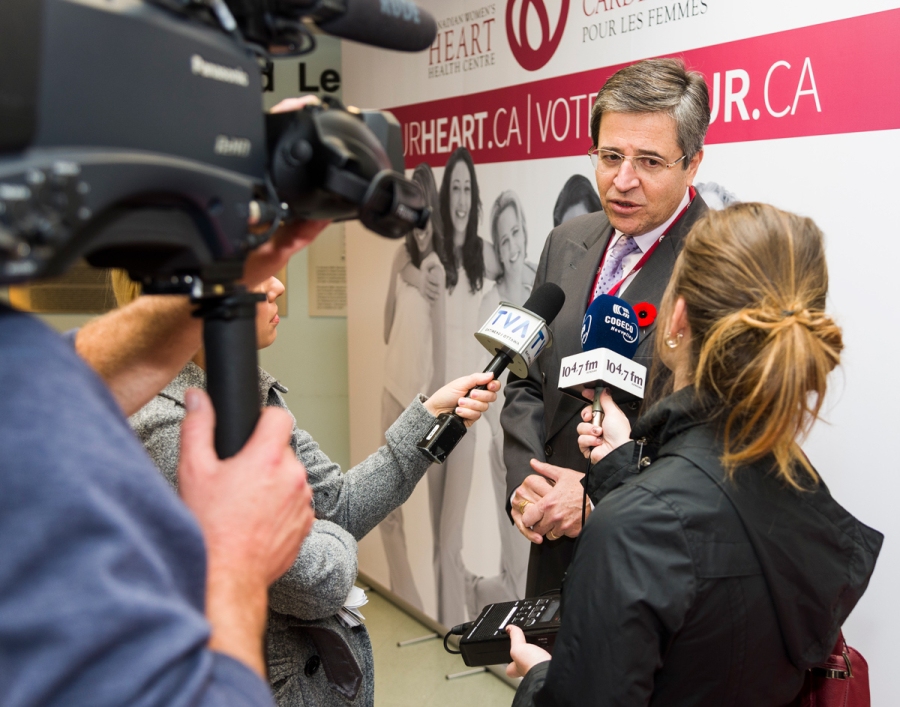
When Dr. Thierry Mesana became president and CEO of the Heart Institute in 2014, he made women’s heart health a strategic priority.
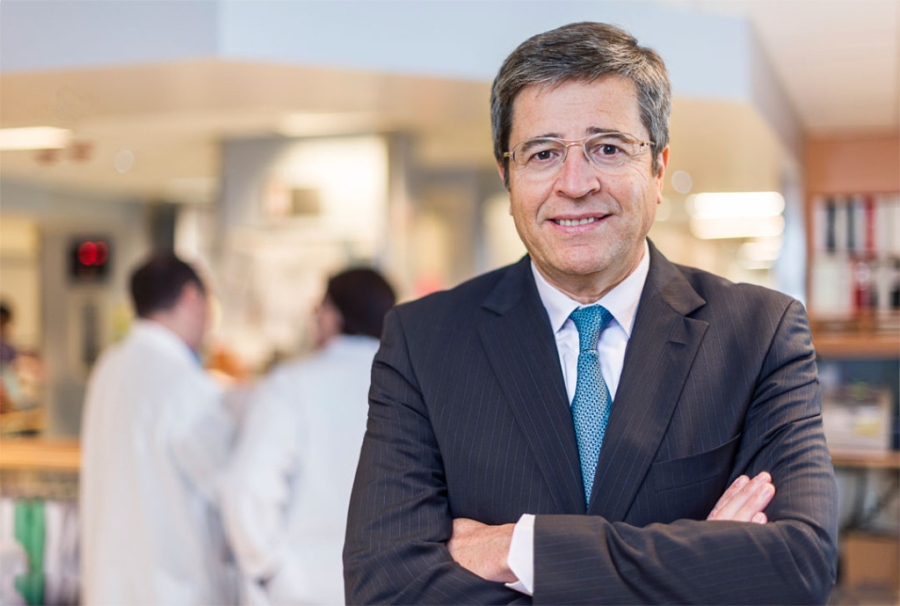
With support from the Ottawa Heart Institute Foundation and the generosity of the community, Dr. Mesana secured the resources needed to turn the idea into a dedicated centre. But he wanted it to be more than a research program.
“I wanted the Canadian Women’s Heart Health Centre to include clinical expertise at the Heart Institute to treat specific diseases of women,” he said.
Dr. Thais Coutinho, a leading cardiologist recruited to the Heart Institute from Mayo Clinic, became an important part of bringing that vision to life. She was appointed to lead the Division of Cardiac Prevention and Rehabilitation after Drs. Pipe and Reid retired, with a mandate to advance women’s heart health.
The pieces were coming together.
On Nov. 7, 2014, the Canadian Women’s Heart Health Centre officially launched as the first centre of its kind, dedicated to ensuring women were well-informed and well-cared for when it came to heart disease.
Lisa McDonnell was the centre’s first manager, while Dr. Michele Turek served as its initial medical advisor. Mullen stepped in to further develop the centre’s scientific and research program.
The women who changed the program
One of the centre’s first major initiatives came directly from women themselves.
Women with lived experience were telling the team that traditional cardiac rehabilitation was not always meeting their needs.
Cardiac rehabilitation could be heavily focused on exercise and dominated by men. Women wanted more emotional and social support—and they wanted it from people who understood what they were experiencing.
Working alongside women with lived experience, the team developed Women@Heart, a peer-support program specifically for women. It has since reached thousands of women and expanded across Canada, with the model now being explored internationally.
For Mullen, who was named the centre’s director in 2019, that kind of patient involvement has been fundamental from the beginning.
“From day one, people with lived experience have helped shape the centre,” she said. “We wouldn’t be where we are today without them.”
Women who once came to the centre for support have become volunteers and peer leaders, helping others navigate their own recovery.
“They came here as patients, and now they’re coming back as volunteers to help other women navigate their own journey with heart disease.”
It is a model that reflects one of the centre’s defining ideas: the people most affected by a problem should have a voice in shaping the solution.
From Ottawa to a national movement
The centre’s work soon expanded beyond its own walls.
In 2016, it hosted the first Canadian Women’s Heart Health Summit (PDF) in partnership with Heart & Stroke, bringing together clinicians, researchers, decision-makers and women with lived experience from across Canada and the United States.
The gathering helped establish a national agenda for women’s cardiovascular health. A subsequent call to action identified 16 priorities, including the creation of a national knowledge-translation network.
That idea eventually became the Canadian Women’s Heart Health Alliance, a volunteer network of experts and advocates working to improve women’s cardiovascular health across the lifespan.
When the Alliance launched in 2018, it had 55 members. Today, more than 350 people across Canada are connected through the network, with people with lived experience serving alongside healthcare professionals as co-chairs across key areas of focus.
For Lisa Comber, a manager with the centre and the Alliance, the Alliance demonstrates what can happen when people doing similar work stop working in isolation.
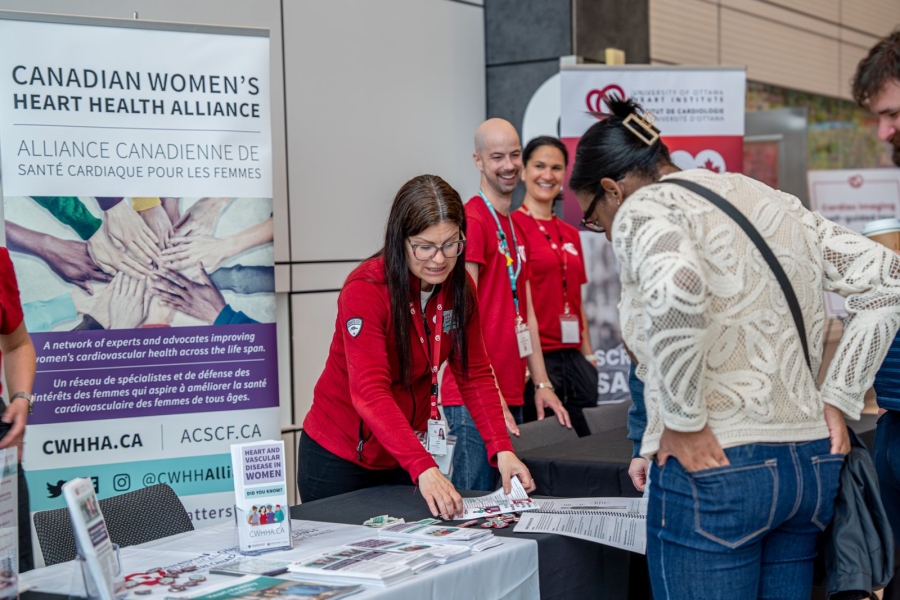
“The goal of the Alliance is to take what other groups are doing well and scale it,” she said. “We work collaboratively to implement evidence, transform clinical practices and impact public policy related to women’s cardiovascular health.”
Comber’s role is to help connect researchers, clinicians, community organizations and people with lived experience, as well as managing and overseeing the Alliance’s projects and programs.
“I love my job. It has meaning. I get to bring people together, identify skills, broker knowledge and connect the dots to help increase our impact on a national scale.”
Video: Dr. Kerri-Anne Mullen, and Lindsay Firestone of the Ottawa Heart Institute Foundation joined CTV Ottawa’s Your Morning to talk about JUMP IN! For Women’s Heart Health, a 30-day movement challenge returning in September to help Canadians get moving for women’s heart health.
Turning knowledge into care
The centre’s national work has grown alongside changes within the Heart Institute itself.
The Women’s Heart Health Clinic, a specialized outpatient cardiac clinic caring for women with heart conditions that are either unique to or more common in women, opened in 2018.
The CardioPrevent Postpartum Program helps women who have experienced an adverse pregnancy event reduce their future risk of cardiovascular disease.
The Heart Institute has also opened the Coronary Function and Imaging Clinic and developed specialized rehabilitation programming and clinical expertise for conditions that disproportionately affect women, including spontaneous coronary artery disease, ANOCA, MINOCA, and other small-vessel diseases.
Research remains a critical part of the work.
Scientists are examining female-specific risk factors across a woman’s lifetime, including pregnancy complications, hormonal factors, and menopause. The centre also advocates for women to be properly represented in cardiovascular research and for studies to analyze results according to sex and gender.
For Mullen, that remains an urgent challenge.
She recalled watching a major cardiovascular study presented at an international congress that had not recruited a single woman.
“How is this happening in 2026?” she remembered thinking.
Women have historically been excluded from some studies because researchers considered pregnancy and hormonal changes too complicated. Yet those same factors can provide important clues about cardiovascular risk.
“There are a lot more questions than answers still. That’s the exciting part of research and why we do it.”
Since 2023, the Alliance has delivered more than 200 presentations across Canada, reaching thousands of people in settings ranging from rural communities to corporate events.
It is another extension of the centre’s original approach: listen to what women need, build the knowledge to address those needs, and then find ways to put that knowledge into practice.
The work is far from finished
Looking back, Dr. Thierry Mesana is proud of what the Heart Institute helped build.
“I’m proud that we did it at the Heart Institute,” he said.
“This is teamwork. I believe in this and support it. But the work has been done by an incredible team.”
For Mullen and Comber, the centre’s story belongs to the many people who have helped build it, including the women whose experiences first revealed what was missing.
More than a decade after those first conversations, the centre has helped move the needle on women’s cardiovascular health.
But there is no finish line.
“I think it’s constant work,” Dr. Mesana said. “It’s not like you have a goal, and once you reach that goal, you can relax.”
The next chapter will require more research, better access to care, stronger national collaboration and continued advocacy.
And, just as it did at the beginning, it will start with listening.
The Ottawa Heart Institute is celebrating 50 years of heart in 2026. Visit our anniversary webpage!
Never miss a Beat
Want interesting stories like this delivered straight to your inbox as they happen?
Subscribe to our mailing list