
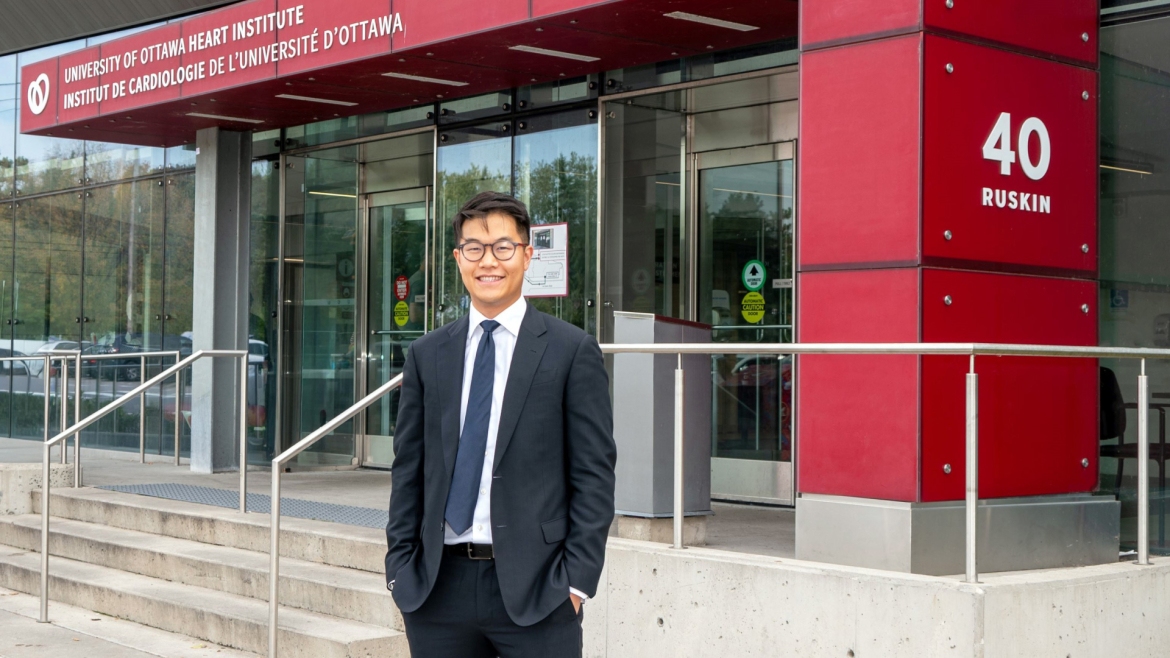
Christopher Sun, BASc, PhD, is part of a new generation of researchers redefining how technology and artificial intelligence can improve patient care. A scientist at the Ottawa Heart Institute and assistant professor at the University of Ottawa Telfer School of Management, Dr. Sun’s work sits at the crossroads of AI, health equity and healthcare optimization. His goal: to make Canada’s health system faster, fairer and more efficient.
Before joining the Heart Institute in 2022, Dr. Sun earned his engineering and doctoral degrees from the University of Toronto and completed postdoctoral research at the Massachusetts Institute of Technology (MIT) Sloan School of Management. His award-winning work has been recognized by the Canadian Institutes of Health Research, the American Heart Association, and the Citizen CPR Foundation. He has published in leading journals, including the Journal of the American College of Cardiology, Circulation, Health Affairs, and Journal of the American Medical Directors Association.
In this conversation with The Beat, Dr. Sun discusses how AI is transforming heart care—from improving diagnostic accuracy to easing the strain on healthcare providers—and why collaboration, fairness and human oversight will be essential as hospitals move toward a data-driven future.
The Beat: Your work uses artificial intelligence to help make healthcare faster, fairer, and easier to access. How are you turning these ideas into real changes for patients and hospitals?
Dr. Christopher Sun: AI helps make healthcare faster, fairer, and easier to access by automating tasks and improving clinical and operational decision-making.

On the clinical side, at the Ottawa Heart Institute, we're developing AI tools that quickly interpret ECGs, freeing up clinicians to focus on complex cases and speeding up treatment, especially in hospitals and cardiac centres with fewer specialists. We're also working on AI that detects findings beyond the heart on cardiac CT scans, flagging potential issues that could otherwise go unnoticed if a second radiologist isn't available.
Operationally, we're using AI to tackle complex problems like operating room scheduling—it's like playing a complicated game of endless Tetris, where mistakes are costly. AI helps streamline schedules, reduce delays, and improve patient satisfaction. These are ongoing projects at the Heart Institute aimed at directly improving patient care and hospital efficiency.
What inspired you to come to Ottawa, and how has the Heart Institute helped shape your research?
The collaboration between the Heart Institute, the University of Ottawa and the Telfer School of Management was a major draw for me. I’ve always been interested in how we can design better, more efficient healthcare systems. Healthcare is, in many ways, the world’s largest service industry—it’s about people, resources and systems working together.
The Heart Institute offers a unique environment where clinical, management, and data expertise come together. The institute and its leadership here have been very supportive of using data analytics and AI to improve patient care with the joint goal of positioning Canada as a leader in this field.
You talk about fairness in healthcare. How can bias show up in health data, and what steps can we take to make sure AI treats all patients equally?
That’s a major concern. AI models learn from historical data, so if the data reflect past biases—say, if women have been underdiagnosed for certain heart conditions—the model will repeat those mistakes.
To address bias, we need deliberate strategies. First, we must improve the quality and representativeness of our data, ensuring accurate diagnoses and balanced representation of all patient populations. Second, we should systematically audit AI models to identify disparities in performance across different patient groups. Finally, instead of simply excluding factors like race or gender, we can sometimes explicitly include and control for these factors to correct biases and ensure fairer outcomes. The goal is to build AI that reduces disparities rather than perpetuate them.
New technology can be hard to bring into hospitals. What are some of the biggest challenges you face when trying to use AI in real patient care?
Implementing AI in hospitals is challenging because the technology evolves faster than healthcare institutions can comfortably manage, and the stakes related to these tools couldn’t be higher. Mistakes can put patients at risk. Success depends heavily on close collaboration among leadership, clinicians, nurses, and researchers, ensuring everyone trusts the tools and understands their role. Realistically, this means addressing messy data issues for model development, carefully validating the tools within existing clinical workflows, and continuously monitoring performance to make sure the AI stays accurate, fair, and genuinely helpful in real patient care.
You’ve worked with hospitals and researchers around the world. What have you learned from those experiences that you’re now applying here in Ottawa?
I’ve been lucky to have mentors who believed research should make a real-world difference. They taught me to focus on problems that matter and to use our skillsets to improve the lives of those around us.
Working with multidisciplinary teams—from clinicians and data scientists in Copenhagen, Cambridge, and Toronto, for example—showed me how powerful collaboration can be. The best solutions come when different kinds of expertise come together early in the process.
You recently won Telfer’s Emerging Researcher Award and hold a Canada Research Chair in Data Analytics for Health Systems Transformation. What do these honours mean to you and to your work at the Heart Institute?
They’re really a reflection of the innovative environment here. The Heart Institute and Telfer have invested heavily in data-driven healthcare, and that support makes these successes possible.
We’ve been fortunate to receive several major grants recently, including from the Canada Foundation for Innovation John R. Evans Leaders Fund and Ontario Research Fund, two Canadian Institutes of Health Research (CIHR) project grants, and a Natural Sciences and Engineering Research Council of Canada (NSERC) award focused on fairness in AI. It’s rewarding to see this work recognized and to know we’re helping to bridge the gap between data science and clinical care.
The Heart Institute is working with Symbiotic AI and the University of Calgary to use AI in treating heart disease. What makes this partnership exciting, and how could it help doctors and patients?
It’s exciting because it brings together research and real-world application. The Calgary team has developed AI tools that have already cleared many scientific and regulatory hurdles.
For us, it’s a chance to accelerate our work and show that Canadian institutions can lead in safely and effectively integrating AI into patient care.
You also mentor students and young researchers. What advice do you give to people who want to use technology to make healthcare better?
First, be curious and critical. Don’t be afraid to share ideas, even if they’re not perfect—that’s how you learn. Second, seek out supportive mentors and peers who can guide you both technically and professionally. Third, when opportunities come, take them. They don’t always come twice. And finally, most importantly, work on problems you care about. Passion and persistence are what sustain you in research.
Looking ahead, how do you think AI will change heart care in the next 10 years, and what role will the Ottawa Heart Institute play in that future?
I think we’ll start by seeing more rollout and use of tools designed to make physicians’ jobs easier—streamlining documentation, imaging and diagnostics. Over time, AI will help guide treatment decisions, offering data-driven recommendations.
But I don’t see a future where AI replaces clinicians. Instead, the best outcomes will come from collaboration between humans and machines—each complementing the other’s strengths.
The Ottawa Heart Institute is well-positioned to lead that transformation and help shape what AI-enabled heart care looks like in Canada.
Never miss a Beat
Want interesting stories like this delivered straight to your inbox as they happen?
Subscribe to our mailing list