

Le Laboratoire de recherche translationnelle en cardiologie explore les mécanismes biologiques à l’origine des arythmies cardiaques, des maladies inflammatoires du cœur et du vieillissement cardiaque, et transforme ces découvertes en nouveaux traitements. Notre travail allie biologie fondamentale, cellules et tissus cardiaques humains, modèles de maladies cliniquement pertinents et développement thérapeutique.
Notre laboratoire se distingue par l'importance qu'il accorde à l'application des découvertes. Plutôt que de s’arrêter aux découvertes biologiques, nos programmes couvrent l’ensemble du continuum de développement thérapeutique : des études mécanistiques sur des cellules et tissus humains aux essais cliniques, en passant par des études sur des modèles animaux de petite et de grande taille, la fabrication des produits thérapeutiques et les démarches réglementaires.
En savoir plus :
Pour en savoir plus, veuillez consulter la page anglaise ou l'information en anglais ci-dessous.
Avis de non-responsabilité : Ce site Web externe n’est pas sous la responsabilité de l’Institut de cardiologie de l’Université d’Ottawa. Son contenu n’est donc pas contrôlé ni révisé et n’est disponible qu’en anglais.

Sur cette page
Publications
Voir la liste des publications actuelles sur PubMed (en anglais) et sur Research Gate (en anglais).
Education
The Cardiac Translational Research Laboratory provides research training to undergraduate, graduate and postdoctoral trainees interested in translational cardiovascular science. Trainees participate directly in hypothesis-driven research spanning molecular and cellular biology, human cardiac models, extracellular-vesicle biology, cardiac electrophysiology, preclinical disease models and therapeutic development.
Regular laboratory meetings, research presentations and journal clubs provide opportunities for scientific discussion, critical appraisal, collaborative problem-solving and professional development. Dr. Davis also contributes to undergraduate and graduate teaching in cardiovascular biology and clinical and translational medicine at the University of Ottawa.
Intérêt principal
Atrial fibrillation and biological therapeutics
A major translational program in the laboratory is focused on developing new biological therapies for atrial fibrillation. We have pioneered the use of human heart-derived extracellular vesicles as a potential disease-modifying therapy that targets the inflammatory and fibrotic substrate responsible for atrial fibrillation rather than simply suppressing the arrhythmia.
Our research investigates extracellular-vesicle uptake and biodistribution, NLRP3 inflammasome and caspase-1 signalling, atrial inflammation and fibrosis, postoperative atrial fibrillation, and local and systemic approaches to extracellular vesicle delivery. The program spans human cardiac cells and tissues, small- and large-animal models, GMP-compatible manufacturing, preclinical safety and efficacy testing, regulatory development and translation toward first-in-human clinical trials.
Inflammatory heart disease and cardiac sarcoidosis
The laboratory studies how myocardial inflammation produces cardiac injury, fibrosis and arrhythmias. Cardiac sarcoidosis is a major focus of this work. We developed the first acquired experimental model of cardiac sarcoidosis, providing a platform to investigate the mechanisms responsible for myocardial inflammation and fibrosis and to identify biomarkers and potential therapeutic targets.
This program combines mechanistic studies with experimental models and human disease to better understand inflammatory cardiomyopathies and develop more precise approaches to their diagnosis and treatment.
Cardiac aging and repair
A third major research program examines the mechanisms responsible for age-related deterioration of cardiac function and the biological pathways that regulate myocardial repair. This work seeks to identify therapeutic approaches capable of preserving cardiac health with aging and restoring endogenous repair pathways.
Translational approach
The laboratory brings together molecular and cellular biology, cardiac electrophysiology, extracellular-vesicle biology, human cardiac tissue, small- and large-animal disease models and therapeutic development. This integrated approach allows discoveries made at the laboratory bench to be tested in clinically relevant systems and, where warranted, advanced through manufacturing and regulatory development toward clinical trials.
Our goal is not simply to describe cardiovascular disease, but to use mechanistic insight to create and test new treatments for patients.
Projets
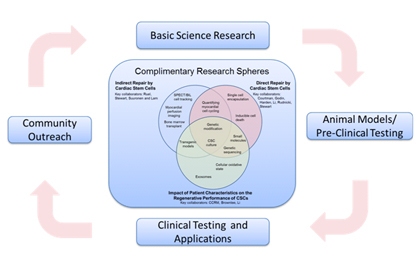
The lab is well positioned to leverage our platform technologies within regenerative medicine. Investigations range from the molecular to the multicellular level with extensive cross-fertilization among projects. This work is made possible through close collaborations within the University of Ottawa Heart Institute (Regenerative Therapies Lab and Inherited Arrhythmia Research Lab) and without (Sprott Centre for Stem Cell Research, Ottawa Hospital Research Institute, Montreal Heart Institute and University of Toronto).
Congestive heart failure is a major health care burden, affecting over 71 million adults (43 million under age 65) in North America, with over 71,000 deaths annually in Canada alone at a cost of over 22 billion dollars to the Canadian economy. These numbers are expected to increase in the coming years given an aging population and advances in other domains of cardiovascular disease.
The strategy of transplanting stem cells into damaged myocardium has emerged as a novel alternative to organ transplantation and ventricular assist devices in the treatment of heart failure. Ideal graft cells should be autologous, easy to expand in vitro, able to engraft and differentiate into functional cardiac myocytes that couple electromechanically with the surrounding myocardium.
We have shown that distinct subpopulations of cardiac stem cells (CSCs) may be isolated directly from cardiac tissue. This advance was based upon studies from the neural literature whereby neural stem cells can be expanded as self-assembling spherical aggregates, termed neurospheres. Our technique simplifies culture methods by focusing on the primary product that is the initial cellular outgrowth from cardiac samples, without recourse to antigenic sub-selection or sphere expansion.
When samples of minced cardiac tissue are cultured, a lawn of flat cells emigrates spontaneously from the plated cardiac tissue. Within that lawn, clusters of CSCs emerge and proliferate. Using mild enzymatic dissociation, loosely-adherent cells surrounding the explant (termed cardiac outgrowth) can be serially harvested. Flow cytometry of these serial collections demonstrate that this spontaneous cardiac outgrowth is enriched, as compared to the native heart, for sub-populations that antigenically resemble CSCs (abcg2+, c-Kit+ and SSEA-1+), endothelial cells (CD31+, CD34+) and mesenchymal cells (CD90+).
When injected into the ventricle of adult Wistar Kyoto rats at the time of left anterior descending (LAD) artery ligation, hearts treated with cardiac outgrowth had reduced ventricular dilation and greater systolic thickening 3 and 6 weeks after myocardial infarction. Invasive hemodynamics performed 6 weeks after myocardial infarction demonstrated lower left ventricular end diastolic pressure and greater maximal contractile element velocity in animals treated with cardiac outgrowth than animals treated with dermal fibroblasts or saline. Histology revealed elongated myocytes derived from injected cells at the border or the endocardial aspect of the infarct. Within the infarct region itself, cardiac outgrowth cells formed discrete clusters of spherical cells surrounded by fibrous tissue.
Recent studies examining the expanded progeny of cardiac outgrowth have demonstrated that in vivo these cells secrete vascular endothelial growth factor, heptocyte growth factor and insulin-like growth factor-1. The direct contribution of these cells to cardiac tissue represents approximately 20 to 50% of the overall increase in capillary and cardiomyocyte densities, suggesting that indirect effects on tissue preservation and/or recruitment of endogenous progenitors significantly contribute to therapeutic outcomes.
Thus the direct outgrowth from cardiac samples provides a promising autologous source of cells that permits ex-vivo amplification, followed by delivery to areas of injury, where they engraft and regenerate the heart.
Projects within the lab are directed towards:
Maximizing the direct CSC transdifferentiation into working myocytes,
Increasing indirect paracrine mediated repair and
Limiting the impact of patient characteristics on CSC regenerative performance.