



OTTAWA, March 30, 2026 — A new Canadian clinical practice guideline developed through the Canadian Cardiovascular Harmonized National Guideline Endeavour (C-CHANGE) and led by researchers at the Ottawa Heart Institute is calling on clinicians to treat heart, brain and mental health conditions together rather than in isolation.
Jodi Edwards explains the significance of the new brain–heart guideline and how it could change care for patients with joint brain and heart conditions.
Published in the Canadian Medical Association Journal (CMAJ), the brain–heart guideline is the first to combine evidence from cardiology, neurology and mental health research to guide care for people living with both heart and brain conditions, a common reality for patients with chronic disease.

“This guideline was motivated by a growing recognition of the important connections between brain and heart diseases as a critical source of multiple chronic diseases in aging populations,” said Jodi Edwards, PhD, director of the Brain and Heart Nexus Research Program at the Ottawa Heart Institute and lead author of the guideline.
“There is a close interplay between heart and brain diseases, with many comorbidities sharing overlapping risk factors, pathophysiological processes, and potential genetic and behavioural connections,” Edwards said. “As a result, heart and brain conditions frequently co-occur and confer reciprocal increased risks.”
The guideline is also notable for embedding patient perspectives throughout its development, helping shape priorities and recommendations. The guideline emphasizes shared decision-making between clinicians and patients, reflecting priorities identified by patient partners involved in the project. Every recommendation also includes sex- and gender-based considerations, highlighting known differences in outcomes and gaps in evidence related to women’s heart and brain health.
Traditionally, clinical practice guidelines for cardiac, neurological and mental health conditions have been developed separately, focusing on individual diseases. Yet many cardiovascular conditions occur alongside neurological or mental health disorders, particularly in aging populations.
Among the 10 practical recommendations for primary care professionals, subspecialists, allied health teams, and patients with cardiovascular risk factors are:
- Screening people with atrial fibrillation for risk of cognitive decline
- Screening for depression in people with coronary artery disease and treating with evidence-based therapies when detected
- Intensive blood pressure lowering in people at increased cardiovascular risk to lower the risk of cognitive impairment
- Intensified cholesterol lowering to prevent heart attack in people with a history of stroke, and to prevent stroke in people following a heart attack
- Routinely offering influenza, pneumococcus and shingles vaccination, especially to people aged 65 and over, to help prevent stroke, heart attack, and vascular cognitive impairment
- Use decision aids to facilitate guideline implementation
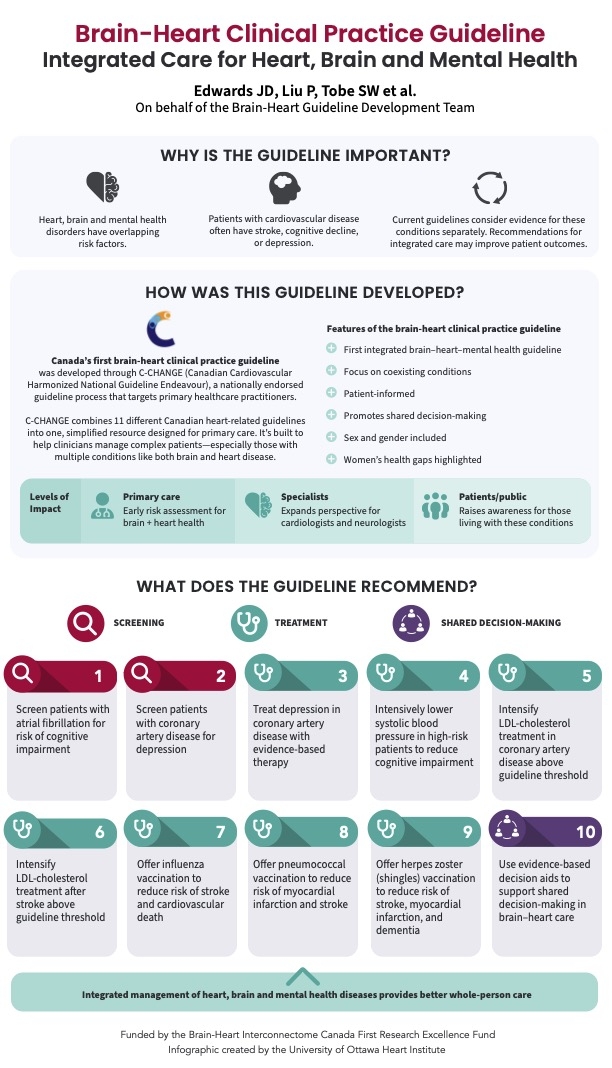
“These recommendations recognize the intricate relationship between heart and brain disease and the importance of screening and treatment of the whole person, rather than a siloed approach,” said Peter Liu, MD, a cardiologist at the Ottawa Heart Institute and scientific director of the Brain-Heart Interconnectome (BHI), a research initiative of the University of Ottawa. “We hope this more holistic approach will be helpful to clinicians and will be a new way of developing clinical practice guidelines in a patient-centred manner.”
This guideline was funded by the BHI, which is supported through the Canada First Research Excellence Fund.
For more information
Media contact
Leigh B. Morris
Communications Officer
University of Ottawa Heart Institute
613-316-6409 (cell)
lmorris@ottawaheart.ca