

Heart disease used to be considered a "man's disease," but no longer. Heart disease is the number one killer of women worldwide and the leading cause of premature death in women in Canada.
Much of what we know about the diagnosis and treatment of heart disease – including conditions of the heart, its valves, arteries and other blood vessels – is based on research in men, but women’s hearts and the way they experience heart disease are different in many ways.
These differences are important because they can affect how heart disease presents in women, and how it's diagnosed and treated. It also affects women’s survival rates.
It doesn't have to be this way.
With the right information and action, it's possible to prevent heart disease or improve your chances of surviving it to lead a healthy life. The Canadian Women's Heart Health Centre can help you take the first easy steps toward a healthier heart by arming you with information.
On this page
Women’s hearts are different
Women generally have higher heart rates and smaller hearts and arteries than men. They have less buildup of plaque in their arteries, and the plaque they do have tends to behave differently.
While male hormones enlarge arteries, female hormones make them smaller, making women's arteries more prone to blood clots or blockages and more difficult to repair.
Some risk factors are different
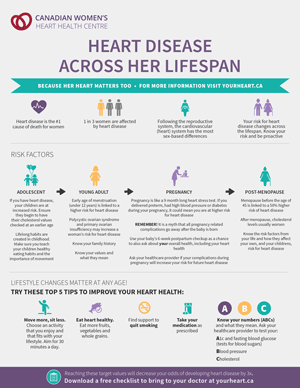
The traditional measures of risk underestimate the dangers for women. While men and women share the most of the same traditional risk factors, some risk factors carry a stronger relative risk in women. Smoking, diabetes, high blood pressure and a family history of heart disease are red flags for women in particular.
The following conditions can lead to a greater risk of heart disease for women:
- Certain pregnancy complications (ex. premature birth, diabetes or hypertension during pregnancy, preeclampsia)
- Earlier than average menopause
- Polyendocrine metabolic ovarian syndrome (cysts in ovaries and hormonal imbalance)
- Systemic inflammatory and autoimmune disorders (ex. rheumatoid arthritis, lupus)
- Cigarette smoking: Cigarette smoking increases the risk of heart attack in women more than men
- Diabetes: Women living with diabetes are 3x more likely to die from heart disease compared to men
Additional resources
Women’s symptoms can be different
Women can experience many of the same heart attack symptoms as men. They may also experience symptoms less commonly associated with a heart attack. While chest pain or discomfort remains the most common symptom in women, some may also experience pressure or pain in the upper back, stomach or abdomen, shortness of breath, and unusual or extreme fatigue.
Because symptoms in women can be less specific, they can be harder to recognize as danger signs.
Heart attack symptoms most often felt by women:
- Chest pain, pressure, tightness, or burning
- Pain in the jaw, neck, right arm, or back
- Extreme sweating
- Shortness of breath
- Stomach pain, nausea or indigestion
Other symptoms women may feel:
- Profound fatigue
- Sleep problems
- Dizziness or light-headedness
- Fast or irregular heartbeat
Women are more likely to present with 3 or more symptoms in addition to chest pain.
If you think you are having a heart attack, get help right away. If possible, call 911. Do not drive yourself.
Additional resources
- Video: Heart attack symptoms most often reported by women
- Infographics: Chest Pain (CardioSmart)
Women develop heart disease later in life
Most women experience their first symptoms or heart attack after the age of 65, while for men the onset is often earlier. But the build-up of artery-clogging plaque can begin as early as the age of 20, so it’s important to take care of yourself at every age.
It’s believed that estrogen protects most younger women from heart complications but once estrogen levels drop during menopause, the risk of heart disease rises.
Being older also means women are more likely to have other conditions, such as diabetes, that further complicate the identification and treatment of heart disease.
Heart disease often looks different in women
Historically, much of the research used to understand and diagnose heart disease was based on studies that included predominantly male patients. As a result, some traditional approaches to diagnosing coronary artery disease have not fully accounted for the ways heart disease can develop and present in women. Women are more likely than men to have heart disease involving smaller coronary blood vessels or to experience reduced blood flow without a major blockage in the large coronary arteries. This can sometimes contribute to missed or delayed diagnosis and treatment.
Over the past 15–20 years, research focused specifically on women and heart disease has produced important evidence about these differences. This growing body of research has helped inform newer medical guidelines and has improved recognition of the different ways coronary artery disease and heart attacks can affect women.
Women and men can have different types of heart disease.
Common types of heart disease:
- Cholesterol build-up in heart blood vessels (coronary artery disease)
- Leaky or stiff heart valves affecting blood flow (valvular heart disease)
- Irregular or rapid heartbeat (arrhythmia)
Women are more likely to have:
- Tear in large blood vessels of the heart (spontaneous coronary artery dissection, SCAD)
- Tightening of the large blood vessels of the heart, limiting blood flow (coronary vasospasm)
- Small vessel disease (microvascular dysfunction)
- Weakened heart due to a stressful event (Takotsubo cardiomyopathy)
- Weakened heart during or after pregnancy (peripartum cardiomyopathy)
Women test differently
Some diagnostic tests that have long been used in cardiology can perform differently in women, sometimes producing less definitive or more difficult-to-interpret results. For example, certain forms of exercise stress testing have historically been less accurate in women, with a greater potential for false-positive results.
Despite advances in research on cardiovascular disease in women, questions remain about which tests and diagnostic strategies are most effective for different groups of women. This is particularly important for women who have symptoms or evidence of reduced blood flow to the heart but do not have significant blockages in the major coronary arteries.
Women may get treated differently
Women remain under-studied and, in some cases, under-diagnosed and under-treated when it comes to heart disease. Historically, women have been underrepresented in cardiovascular research, and important differences in how heart disease develops, presents, and responds to treatment in women have not always been adequately recognized.
Many people, and some healthcare professionals, may still be unaware that women can experience different symptoms and types of heart disease than men and may sometimes require different diagnostic approaches. These differences can contribute to underestimating the severity of cardiovascular disease in women, potentially resulting in delayed diagnosis or less appropriate treatment.
Although significant progress has been made, gaps remain in research, diagnosis, and treatment of heart disease in women.