


The 19th Annual Ottawa Conference: State of the Art Clinical Approaches to Smoking Cessation to be held on January 22 and 23, 2027 at the Roger’s Centre located in downtown Ottawa.

Clinical practice guidelines emphasize that healthcare providers should consistently identify and treat all tobacco users using available medication and support. But, evidence alone is not enough to change routine care. There is a need to change healthcare practices so that smoking cessation treatment is provided as part of routine care to all patients who are tobacco users.
The Ottawa Model for Smoking Cessation (OMSC) was created to address this need.
The Ottawa Model for Smoking Cessation:
- Is a validated, evidence-based process that combines knowledge translation and organizational change practices to implement smoking cessation treatment and support as part of routine care.
- Is adaptable to any type of healthcare setting and is currently being implemented in over 500 sites across Canada.
- Has been shown to increase how often healthcare providers advise and assist smokers trying to reduce or quit, which leads to: increased long-term smoking abstinence rates, reduced downstream healthcare use, and reduced premature risk of death.
- Results in the identification, treatment, and follow-up of smokers as part of routine care.
- Is cost-effective, from the hospital payer perspective, and results in fewer healthcare costs of patients who receive the program.
About the Ottawa Model
The OMSC can be understood with one simple equation:

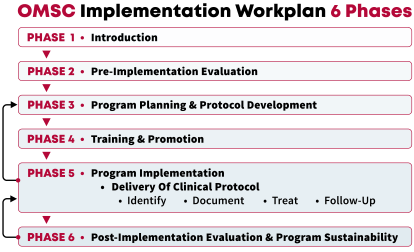
Expert OMSC Implementation Specialists work with partner sites to adapt their clinical practices to include smoking cessation treatment as part of their routine protocols. A detailed six-phase OMSC Implementation Workplan is used to facilitate this process. During the practice change process, an Evidence-Based Smoking Cessation Treatment Protocol is created specifically for each site. Once the smoking cessation program is launched, feedback and quality improvement processes allow the program to be refined and sustained over time.
Adapting the OMSC program to individual healthcare settings leads to the consistent identification, documentation, treatment, and follow-up of all patients or clients who smoke, which in turn results in more quit attempts and, ultimately, more smokers becoming smoke-free.
OMSC Implementation Workplan 6 Phases
Mission
Our mission is to assist healthcare organizations to transform their clinical practices for the appropriate treatment of smokers through knowledge translation, implementation support, and quality evaluation. In doing so, our aim is to assist as many nicotine users as possible by ensuring the provision of effective, evidence-based nicotine-dependence treatment, delivered by knowledgeable healthcare professionals.
Values
The Ottawa Model for Smoking Cessation reflects the following principles:
- QUALITY: OMSC embodies an efficient, comprehensive, and evidence-based approach to clinical smoking cessation practice and evaluation.
- COLLABORATION: We collaborate with leading healthcare professionals, scientists, and organizations to develop practical and effective treatment options for smokers.
- COMPASSION: We demonstrate compassion for smokers, regardless of intention to quit, by providing non-judgmental, accessible care and support.
To become an OMSC partner, apply below:
Hospital site (PDF) or Primary care site (PDF)
Please send completed application to @email
Contact
Telephone: 613-696-7065 or
Toll free: 1-888-761-OMSC (6672)
Fax: 613-696-7112
Email: OMSC@ottawaheart.ca